

In recent months, the debate surrounding the “Valle d’Itria and Costa dei Trulli” DMO has taken on the tone of a dispute from a bygone era. While regional guidelines clearly point toward integrated management between the coast and the hinterland, local resistance is emerging in Martina Franca and Locorotondo. This resistance, cited in the name of “historical consistency,” seeks to narrow the destination’s boundaries.
As consultants at Destinalytics, we view this stalemate with concern. The risk is confusing a tool for economic governance and international promotion with a nostalgic exercise in historiography—or worse, bending a market vision to fit territorial logics that ignore the actual flows of global tourism.
In this article, we clarify what Destination Management truly is and why, for a territory of excellence like the Valle d’Itria, abandoning integration with the coast would be a strategic error lacking any analytical basis.
What is a DMO (really)?
A DMO (Destination Management Organization) is the strategic entity responsible for the management and coordinated promotion of a territory. It is not a simple marketing office; it is the technical “control room” that transforms a geographical area into a competitive tourism product, harmonizing the interests of public and private actors under a single, data-driven vision.
Operationally, the DMO ensures that all elements of a destination—attractions, services, infrastructure, and marketing—work synergistically. Its goal is to maximize the economic value of the region and optimize the visitor experience, guaranteeing long-term sustainability.
It is vital to understand that destination management is far more complex than marketing. While marketing attracts tourists, management ensures the territory is ready to welcome them, that services are efficient, and that flows are intelligently distributed between the coast and the hinterland.
To use a metaphor: if the territory is an orchestra of villages, hotels, and natural attractions, the DMO is its conductor. It is the entity that ensures every instrument plays the same sheet music to attract the right flows and generate real wealth, avoiding the cacophony of parochialism.
The market has already moved toward integration, ignoring borders.
Beyond administrative borders lies the reality of a destination that the world already perceives as one. Confirming this systemic vision, an analysis of non-hotel accommodation distribution offers unequivocal data. Mapping listings on Airbnb (represented by the red dots in the image) reveals a nearly uniform density saturating the entire axis between the Valle d’Itria and the coast.
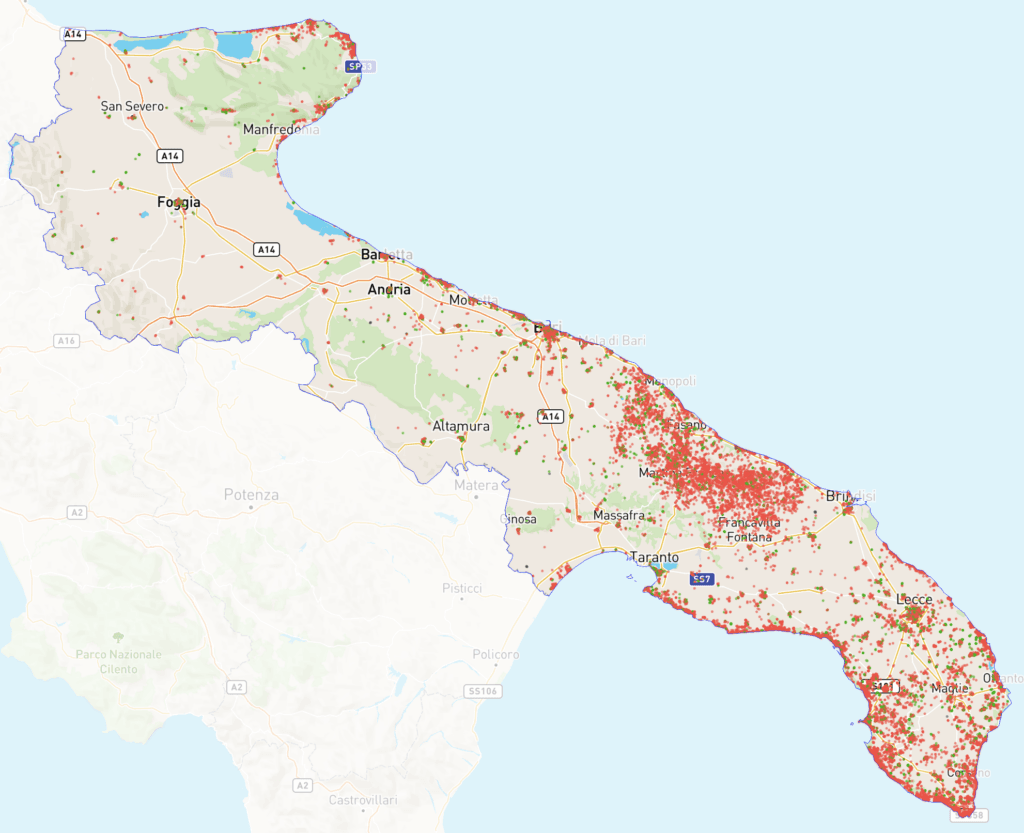
This continuous “cluster” of hospitality proves that the market does not operate in silos. Tourism demand expands fluidly, occupying physical space based on the appeal of the experience rather than administrative topography. Consequently, the supply has structured itself following this spatial continuity.
In terms of Destination Management, this map tells us that attempting to separate the coast from the hinterland is not just a theoretical error, but an action in direct conflict with the economic reality of the region. Managing these areas with different—or worse, competing—strategies creates a misalignment between political governance and actual consumer dynamics, weakening the effectiveness of any international promotion.
Financial sustainability: where the critical mass lies.
If strategy is the engine of a DMO, economic resources are the fuel. An analysis of tourist tax (occupancy tax) revenues for 2024 highlights a financial asymmetry that cannot be ignored.
The coastal municipalities—led by Fasano, Monopoli, and Polignano a Mare—generate the vast majority of total revenue. On their own, the top three coastal towns exceed 3 million euros, while the “heart” of the Valle d’Itria (Cisternino, Martina Franca, Locorotondo) records figures that, individually, would not allow for any high-level management autonomy.
From a Destination Management perspective, this data clearly indicates that a hypothetical “Valle d’Itria only” DMO would lack the resources necessary to invest in infrastructure, qualified human capital, and international marketing campaigns.
Separating from the coast means condemning the Valle d’Itria to an operational irrelevance, leaving the territory without true technical direction. The financial critical mass of the coast is the guarantee of the hinterland’s future.
Flow compensation: a win-win strategy for the region.
Analyzing seasonality through monthly occupancy data reveals a phenomenon of extreme strategic interest.
Coastal municipalities show a much sharper seasonality curve, with summer peaks that often push infrastructure and hospitality quality to the breaking point. Conversely, the inland villages demonstrate greater resilience during the “shoulder months” (spring and autumn), recording performance that is proportionally higher than that of the coast.
This asynchrony represents a massive opportunity for unified governance. Integrating the coast and hinterland into a single DMO enables a win-win solution for balancing flows:
- In Summer (Load Balancing): The DMO can act to “ease” pressure on the coast by diverting flows toward the hinterland for day trips, events, and stays in masserie, protecting the tourist experience and avoiding overcrowding.
- In the Shoulder Months (Re-marketing): The Valle d’Itria, which enjoys strong cultural and gastronomic appeal during these periods, acts as a driver for the coast, encouraging visitors to explore the seaside even out of season for outdoor activities, boating, or relaxation.
Governing the territory in a fragmented way condemns each municipality to manage its own peaks and troughs in isolation. Managing it as a single Destination allows seasonality to be transformed into a continuous economic cycle, where the coast and the hinterland support one another throughout the year. This is the true essence of Destination Management: not simply enduring tourism, but directing it strategically to maximize value twelve months a year.
Toward Excellence in Governance: the future doesn’t wait for borders.
The era of “bell-tower politics” is incompatible with the pace of the global market. As the data shows, the “Valle d’Itria and Costa dei Trulli” DMO is not a gamble; it is the acknowledgment of a mature economic and social reality.
Flow exchange data, the widespread distribution of accommodation, and the financial critical mass generated by the coast deliver an unavoidable truth: we are already one Destination. Continuing to argue over administrative borders or historical consistency means willfully ignoring the tools that could grant this region an unprecedented leap in quality.
Ultimately, choosing integration does not mean “watering down” the identity of the Valle d’Itria. On the contrary, it means providing every single village with a strategic shield, capable of protecting local authenticity through professional flow management and high-level international promotion. It means moving from “enduring tourism” to “governing the regional economy.”
The challenge for today’s and tomorrow’s administrators is not to defend a line on a map, but to have the courage of technical vision. Puglia has charted a clear course with the Puglia Destination GO project; it is now up to the local territories to decide whether to remain a sum of small individualities or to become a destination capable of competing globally.
At Destinalytics, we are convinced that the beauty of the Valle d’Itria deserves this courage. Behind every data point is an opportunity for growth, and behind every strategy is the future of our land.
The future of our Destination is written in the data. It’s time to start reading it together.
Check out our article on Airbnb and the future of our cities to explore global regulatory trends.
Trasforma i dati in strategie per la tua destinazione.
Prenota la consulenza gratuita →




Leave a Reply