


The Region Adopts the “Tuscany Model” to Regulate Vacation Rentals
Puglia has officially launched its legislative overhaul for the regulation of short-term rentals. With a bill consisting of nine articles, the Regional Government (led by Antonio Decaro) aims to introduce a governance model inspired by the recent experience in Tuscany.
In Italy, two other regions—Emilia-Romagna and Tuscany—have already attempted to regulate what the former Minister of Tourism, Daniela Santanchè, repeatedly called the “Wild West” of short-term rentals.
Initially, these regulations were challenged by the national government for exceeding regional jurisdiction. However, with ruling no. 186 of 2025, the Constitutional Court ruled in favor of Tuscany’s regional law (no. 61/2024). 61/2024.
Backed by this precedent, Puglia is now preparing to adopt these core principles in an effort to rebalance the relationship between tourist hospitality and the daily lives of residents.
This topic is extremely sensitive as it involves many stakeholders with conflicting interests. Before analyzing the technical details of the law, we will explore the Puglian context and the various perspectives involved through market data and dynamics.
Il contesto: un decennio di crescita senza precedenti
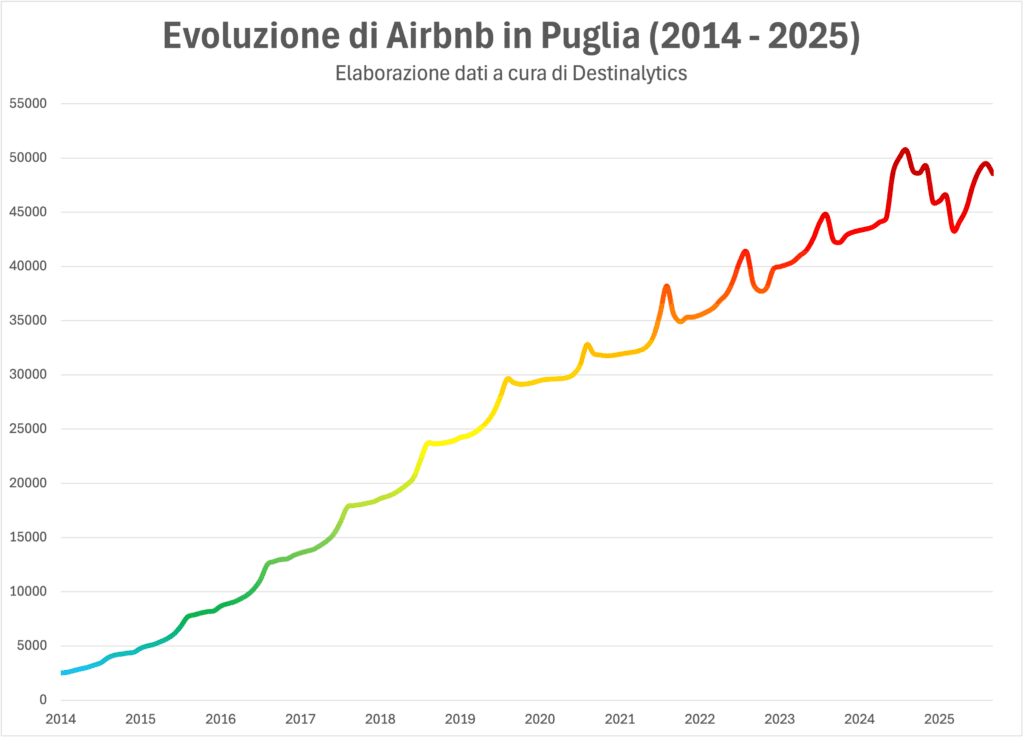
Tourism is now one of Puglia’s most vital sectors, contributing 9.5% to the regional GDP. The exponential growth of tourism in Puglia over the last decade is the result of several converging factors:
At year-end 2025, Puglia has 44,883 properties listed for short-term rentals.
DMS Regione Puglia
It is important to note that the geographic distribution of these listings is not uniform; as shown in our mapping, they are heavily concentrated in the “Costa dei Trulli and Valle d’Itria” area and along the Salento coasts.
I punti di vista degli stakeholder
1) The Owners’ perspective
Beyond benefiting the tourism sector as a whole, short-term rentals have allowed owners of second homes—often inherited—to monetize those properties. Many prefer short-term stays over long-term rentals not only for the significantly higher profitability but also for greater protection against payment defaults or eviction issues, which in Italy involve long and complex legal procedures.
This model has allowed many families to renovate and open previously unused properties. It provides the flexibility to use the home for personal purposes at any time while generating income that, in an era of inflation, helps support family expenses—such as university fees for children or primary home mortgages.
2) The Hotel Sector
The hotel industry has always voiced strong reservations regarding the uncontrolled expansion of short-term rentals. They cite regulatory disparities in tax, administrative, and safety requirements. While hotels are subject to strict protocols (from fire prevention to urban compliance and high labor costs), short-term rentals enjoyed a simplified regime for years, fueling a perception of “unfair competition”.
The ubiquity of tens of thousands of private listings has undeniably eroded the market share of traditional facilities by intercepting demand segments that previously had no alternative.
However, one must avoid generalizations: while “grey areas” of unauthorized rentals persist, thousands of hosts have elevated non-hotel hospitality to levels of excellence, professionally contributing to the region’s value.
The rise of Airbnb has blurred the traditional boundaries between the residential rental market and the tourist accommodation sector.
3) The Housing Crisis
Young families without property, commuters, and long-term renters are struggling, particularly in high-density tourist towns.
The mechanism is purely economic: the housing supply is rigid. If the supply of long-term rentals decreases because properties are moved to the short-term market, rents go up. Consequently, residents are forced to pay higher rates or move to peripheral areas far from essential services.
4) The Depopulation of Historic Centers
The risk of historic centers being emptied is a real global phenomenon, though the causes are not always tourism-related. Many centers suffered from structural decline for decades.
Take Locorotondo as an example. The exodus from the historic center began long before the arrival of tourism. The structural nature of the cummerse (traditional multi-story dwellings with steep stairs, no elevators, and far from parking) had already pushed many residents, especially the elderly, to move to more comfortable modern housing. It was only after 2010, thanks to the conversion of some homes into alberghi diffusi (scattered hotels), that the center was revitalized.
In this specific case, tourism did not displace residents; it acted as a catalyst for regeneration, saving an architectural heritage that risked total abandonment.
This is not an isolated case. In many cases, the diffusion of tourist rentals has favored the recovery of lodgings in disuse, contributing to the valorization of the local real estate heritage of prestige, such as trulli and masserie, identity elements of the architecture and of the culture of the territory.
A different matter—one that is indeed attributable to tourism—is the loss of local identity, the commodification of culture, and the erosion of that very authenticity which, paradoxically, is one of the main draws for tourists themselves.
The Proposed Regional Law
The challenge is to find a balance between protecting private property, welcoming tourists, and ensuring urban livability.
The Puglia Region had the courage to accept this challenge, which is by no means simple, and did so with a bill that revolves around a pivotal principle that is not an ‘ideological’ ban, but the transition from spontaneous and disordered growth to regulation guided by data and the specific needs of every territory.
Article 2: The Urban Planning Lever for Mayors
The heart of the law lies in the power granted to provincial capitals and high-density tourist municipalities. The law allows Mayors to identify specific zones (such as historic centers) where tourist rental activities can be limited or capped.
However, these restrictions cannot be arbitrary. To limit activity in a certain area, Municipalities must rely on objective, measurable parameters, including:
The approval of this law would mark a paradigm shift for Puglia.
Stay Updated with Destinalytics
In our upcoming articles, we will analyze the detailed impact of these regulations on Puglian municipalities and monitor the legislative progress in the Regional Council.
Ensure you don’t miss the latest updates on tourism in Puglia: leave your email address to receive a notification when we publish new articles.
Stay updated.
Book your free consultation




Leave a Reply