

With the 2026 summer season over, it is time to take stock for Locorotondo and the entire Itria Valley.
Preliminary data point to a year with decidedly positive overall volumes: in the first nine months of 2026, according to figures from the PayTourist platform, overnight stays in Locorotondo exceeded 140,000 (140,349, to be precise), marking a net increase of +8.4% on the 129,440 recorded in the same period of 2025.
The months of May and July drove this performance in particular, both with growth rates above +13% year on year. Figures which — pending official ISTAT validation — confirm the village’s appeal and a trend that extends to neighbouring municipalities: the Itria Valley is consolidating its position as one of the most sought-after tourism hubs in southern Italy.
The “Borghi italiani online 2026” report by the Telepass Observatory ranks Locorotondo fourth in the national online-search ranking, with an extraordinary peak between November and January thanks to the Christmas decorations that attract thousands of visitors. To be precise, 471,000 users searched for Locorotondo in those three months in 2025.
The strength of foreign markets and the dichotomy of flows
Analysing the monthly trend curves, the real engine of this growth emerges clearly: international demand, coming mainly from France, the Netherlands, the United Kingdom, the United States, Germany and Belgium.
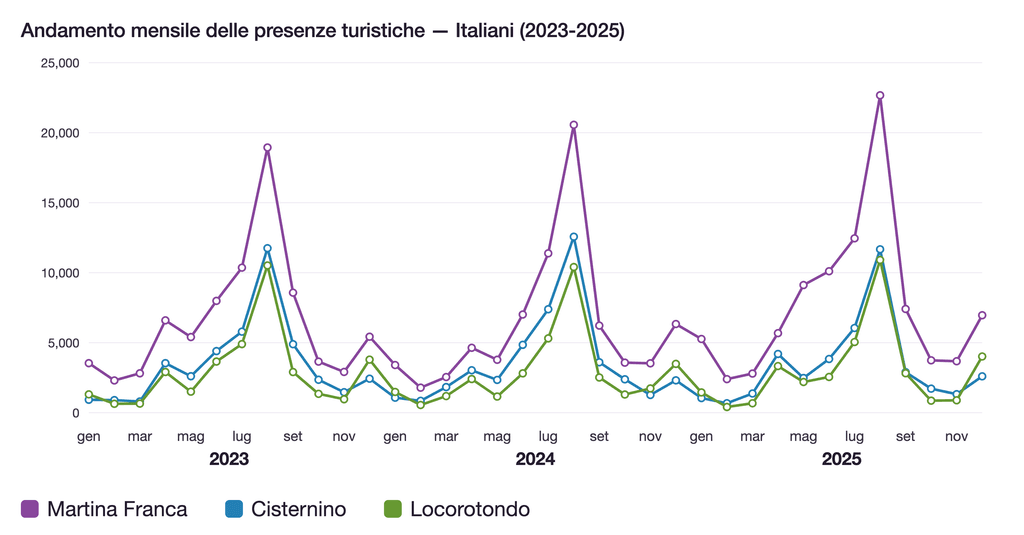
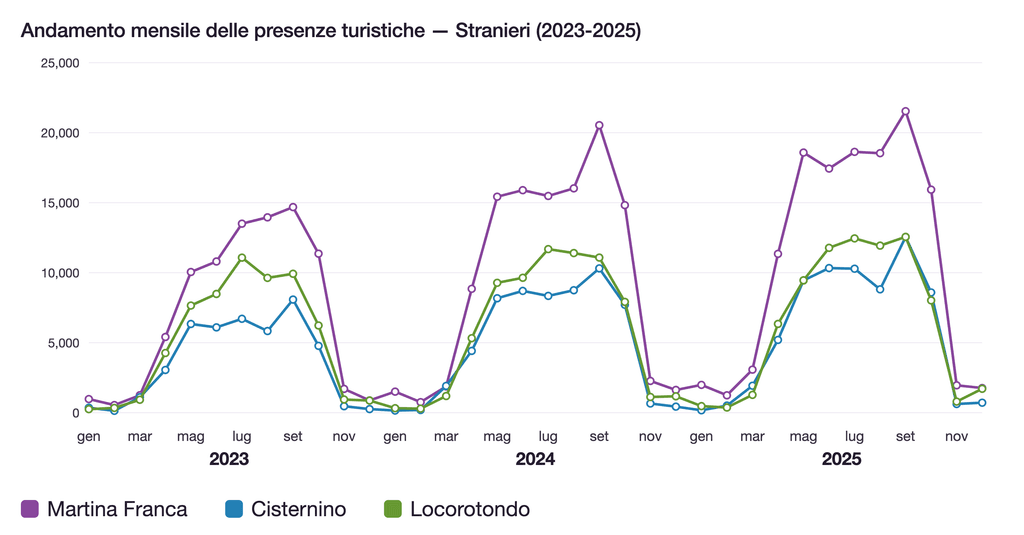
As the charts clearly show, the foreign market follows a seasonality diametrically opposite to that of the domestic market. While Italian tourists remain tied to the corporate holiday calendar, concentrating in the August peak, foreign demand spreads across the shoulder months (May, June and especially September). A choice also driven by climate change: foreign visitors deliberately avoid the scorching heat of the summer months, which increasingly reaches 40°C, preferring milder temperatures for cycle tourism and to experience the villages without the strain of overcrowding.
Tourism supply data for Locorotondo
On the supply side, cross-referencing the various databases (ISTAT, SPOT, PayTourist, Airbnb) reveals discrepancies, due both to undeclared activity and to persistent regulatory uncertainty in the classification of properties. There is, however, one unequivocal figure that defines the identity of local hospitality: accommodation in the Itria Valley is overwhelmingly dominated by short-term rentals.
According to figures from the Regional Observatory, Locorotondo has 6 hotel establishments (including hotels and scattered hotels), compared with 138 non-hotel businesses (B&B, holiday homes, guest houses) and no fewer than 352 registered short-term rentals. In other words, second homes rented out by private owners account for over 70% of recorded accommodation, a share that rises to 86% when active Airbnb listings are analysed. Of a total of 3,088 official beds, 2,829 belong to non-hotel accommodation and short-term rentals (91.6%!), while hotels provide just 259.
This configuration is not common to established tourism destinations, which already had a solid hotel network before the advent of digital portals. In the Itria Valley, instead, two phenomena coincided perfectly: the widespread diffusion of Airbnb (launched in Puglia around 2014) and the international consecration of Puglia as a tourism destination. In this scenario, second-home owners promptly seized an unrepeatable opportunity: renovating the rural property stock (trulli, lamie and masserie, often with the support of regional incentives and GAL calls) and making it available to tourist flows.
The critical average occupancy figure: supply outrunning demand
In 2025, the average bed occupancy rate in Locorotondo stood at just 9.9%. A figure calculated by comparing actual overnight stays with theoretical annual capacity (beds × 365 days), which places the village at levels similar to Martina Franca (10.2%), Ostuni (10.4%), Alberobello (23%), Fasano (19%), Cisternino (11.7%) and Ceglie Messapica (4.6%).
One might object that micro-accommodation does not operate all year round: yet even assuming a season reduced to 200 opening days, average occupancy would rise only to 18.1%.
It is also necessary to allow for a margin of “undeclared activity”: according to some estimates, about a third of overnight stays are not reported by operators to the regional SPOT system. But even including this untracked share, the order of magnitude of the problem does not change: the local market suffers from a growing structural imbalance between demand and supply.
A historical comparison suffices: in 2014 Locorotondo had 360 beds against 20,374 overnight stays. In just eleven years, with demand more than quintupling (+448%, over 111,000 overnight stays), accommodation supply multiplied by more than eight and a half times (+758%), exceeding 3,000 recorded beds. A vertiginous growth that today exposes the destination to an evident dilution of occupancy rates.
The oversaturation of the micro-accommodation market in the Itria Valley
In economics, this scenario has a precise name: market oversaturation. When a multitude of similar properties compete to capture the same flows, the consequences are inevitable: a race to the bottom on rates, erosion of operating margins and growing dependence on the online booking multinationals. These digital giants have recently changed their commission models, shifting commissions of up to 15.5% onto hosts, on top of increasingly stringent regulatory and tax requirements.
Faced with this saturation, which directions will the local market take? Margin compression will open an inevitable phase of restructuring that will outline three distinct scenarios:
- Exit from the market: some owners, facing reduced earnings and growing management burdens, will abandon hosting. This transition could favour a return to long-term residential rentals, easing the grip of a housing crisis that is now unsustainable for residents and local workers.
- The leap towards professionalisation: those who decide to remain in the market will have to make a leap in professional quality. Some will delegate management to structured property-management companies; others will choose to invest in their own competitiveness, focusing on disintermediation and direct channels to protect revenues.
- The risk of speculation: finally, there will be those who decide to cash in by selling to speculative investors now entering the Itria Valley, with the concrete risk of permanently removing those homes from the residential fabric and the local community.
In this context, governing tourism over the next ten years will require measured and courageous choices, both for individual operators and for those called to administer our territories.
It is from this awareness that the Destinalytics project takes shape: a permanent Territorial Tourism Observatory for the Itria Valley. By integrating scientific research with quantitative flow analysis, the goal is to give our destination a solid analytical compass: an indispensable tool for stopping sailing by sight and planning the future, offering strategic certainty to local businesses and public administrators alike.
From data to strategy: how Destinalytics can support sustainable tourism growth
In a competitive context where global demand evolves rapidly, relying on intuition or end-of-season reports is no longer enough. To build a profitable and sustainable tourism future, vision, predictive analysis and destination-management expertise are required.
At Destinalytics we turn tourism Big Data (tourist tax, OTA flows, search behaviour and digital sentiment) into high-impact operational tools. Here is how we act on the two key fronts of the ecosystem:
For municipalities, DMOs and public administrations:
- Destination development strategic plans: we design territorial tourism governance based on objective data, directing investment towards high-value target markets and fostering genuine seasonality reduction.
- Monitoring and territorial intelligence: dedicated dashboards to understand origins, average length of stay, accommodation pressure and economic impact in real time, anticipating trends rather than chasing them.
For hospitality businesses, prestige properties and hospitality entrepreneurs:
- Digital and positioning audit: we analyse your online presence, reputation and the competitiveness of your offer relative to the destination’s actual flows.
- Revenue and international marketing strategies: we help you capture the most profitable foreign markets (USA, UK, Northern Europe) with direct-sales strategies and channel diversification, maximising RevPAR in the shoulder months.
Do you want to prepare your destination or your property for the challenges of 2027? Do not wait for next season to understand how the market is moving. The data for making the right decisions already exists: all you need is the method to make it speak.
Our services
Turn data into decisions for your property
Tourism flow analysis, data platforms and training for destinations, businesses and public bodies.
- Flow analysis
- Data platforms
- Training




Leave a Reply